01
Start with contract pressure.
Review rows where volume, open interest, premium value, IV rank, and side bias line up in one specific contract.
ConvexRadar gives new users a practical look at the ranking model: contract pressure, IV context, catalysts, and risk flags. Upgrade when you want the full sortable scanner workflow, saved contracts, and richer contract research tools.
A simple read on the day’s scan tone so users understand whether options demand is leaning bullish, bearish, or mixed.
Free users can learn why volume/open interest, IV rank, gamma, delta, earnings, and news catalysts matter before paying.
Paid access is where the app should expose the actionable workflow: full sortable rows, richer filters, catalysts, and charting.
Both paid plans start with a 5-day free trial. Founder Beta keeps the scanner workflow moving forward; Pro is for Social, smart alerts, social heat, P/L journal tools, and dark-pool context as those features ship.
| ★ | Score | Stock $ | Ticker | C/P | Sector | Type | Strike | Exp | Price | Delta | Gamma | G/P Ratio | IV Rank ↑ | Vol | OI | V/OI | $ Flow | Earnings | Squeeze | |
|---|---|---|---|---|---|---|---|---|---|---|---|---|---|---|---|---|---|---|---|---|
| 92.4 | NVDA | C | $950 | 6d | $4.20 | 0.35 | 0.028 | 0.0067 | 28 |
12,400 | 3.9x | 72% | — | |||||||
| 85.7 | TSLA | C | $290 | 6d | $2.85 | 0.30 | 0.032 | 0.0112 | 45 |
8,900 | 4.9x | — | EARNINGS in 25d | |||||||
| 81.3 | META | C | $600 | 13d | $6.50 | 0.38 | 0.018 | 0.0028 | 18 |
5,600 | 1.4x | 85% | EARNINGS in 26d | |||||||
| 78.2 | AAPL | P | $235 | 6d | $1.90 | -0.28 | 0.025 | 0.0132 | 12 |
15,200 | 1.7x | — | — | |||||||
| 74.8 | AMZN | C | $210 | 13d | $3.40 | 0.32 | 0.022 | 0.0065 | 22 |
4,300 | 1.5x | 61% | EARNINGS in 27d |
Flow: summarizes contracts with the strongest option-chain pressure, split by bullish and bearish demand, using chain-derived block/sweep proxies and estimated premium dollars.
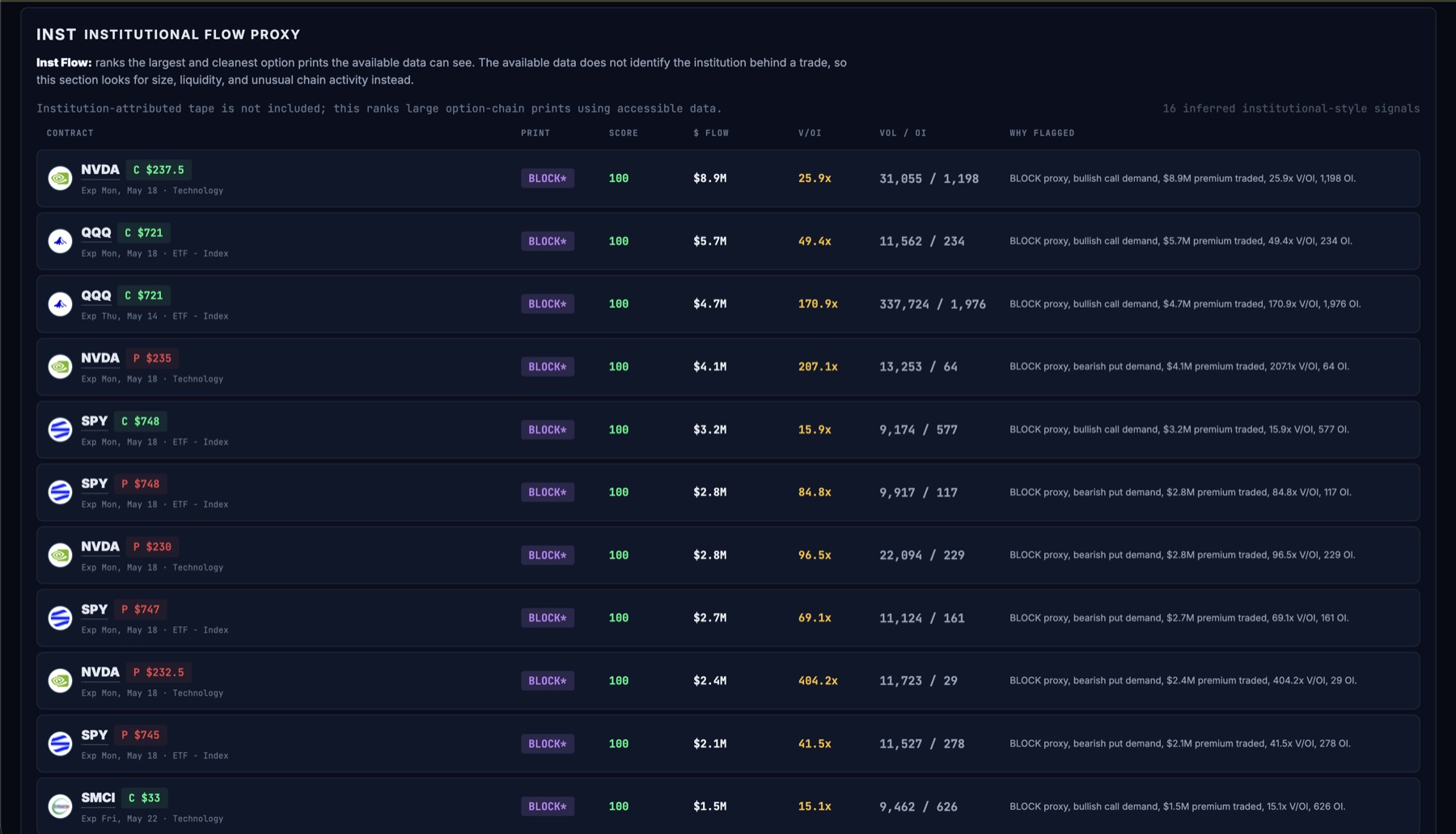
Inst Flow: ranks the largest and cleanest option prints the available data can see. The available data does not identify the institution behind a trade, so this section looks for size, liquidity, and unusual chain activity instead.
Gaps: tracks notable price gaps and continuation tendencies. Use it to see whether a stock is already moving hard before the options chain confirms follow-through.
Regulatory filings: shows fresh public regulatory filings for the active stock universe. No filings data key is required; the app uses public filing submissions and archive links with request caching and ETF noise filtered out.
Current report for material events shareholders should know about, such as leadership changes, deals, guidance, financing, legal events, or major corporate updates.
Insider ownership change filed by directors, officers, or 10% owners. Watch for open-market buys/sells, option exercises, and repeated insider activity.
Quarterly holdings report from large institutional investment managers. Useful for delayed fund-positioning context, crowding, and major position changes.
Beneficial ownership reports. These can matter when a large holder, activist, or passive owner crosses reporting thresholds or changes a meaningful position.
Registration statements for new securities or shelf offerings. For public names, these can imply dilution or financing pressure and often matter more for puts.
Prospectus or offering supplement. Useful for spotting finalized offering terms, convertibles, debt, shares, warrants, or other financing details.
Quarterly report with unaudited financials, management discussion, and risk updates. Useful for checking whether fundamentals support the options setup.
Annual report with audited financials, business overview, risk factors, and full-year management discussion. Best for deeper fundamental and risk context.
Calendar: combines active-universe earnings with broader market catalysts like Fed rate decisions, FOMC minutes, CPI, PPI, jobs data, and other macro events that can shift volatility and direction.
Targets: tracks analyst price-target raises, cuts, upgrades, downgrades, and initiations from free news-derived sources. These updates can become directional catalysts when they line up with unusual flow.
News: headline feed for tickers in the active scan. It helps explain whether a contract-pressure spike has a current catalyst behind it.
Support: send bug reports, feature requests, account/data questions, service requests, or workflow issues directly into the owner Telegram workflow. Reports include your signed-in account plus page context so issues can be reproduced faster.
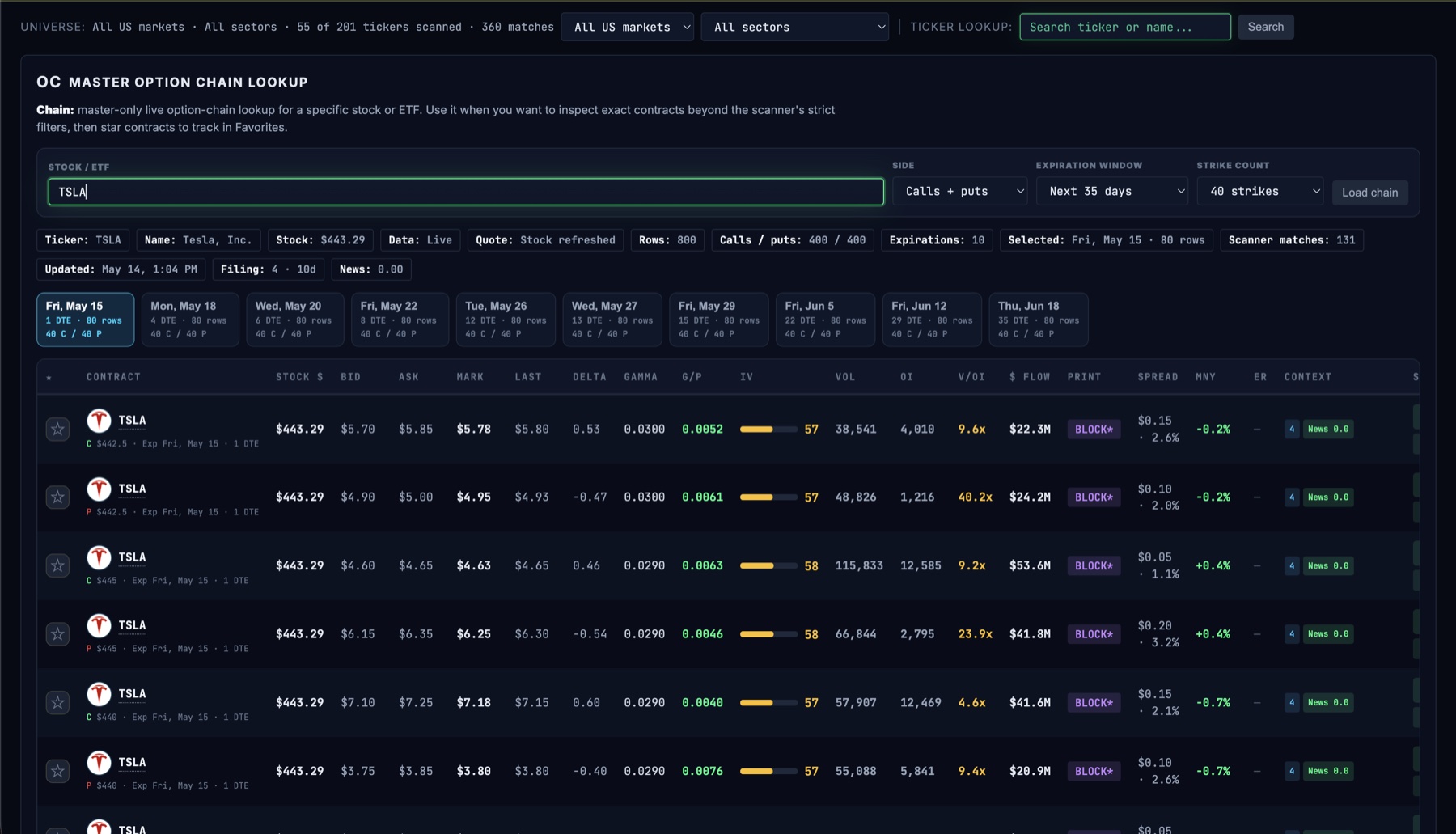
Chain: Founder and Pro option-chain lookup for a specific stock or ETF. Use it when you want to inspect exact contracts beyond the scanner's strict filters, then star contracts to track in Favorites.
| ★ | Contract | Stock $ | Bid | Ask | Mark | Last | Delta | Gamma | G/P | IV | Vol | OI | V/OI | $ Flow | Spread | Mny | ER | Context | Score | |
|---|---|---|---|---|---|---|---|---|---|---|---|---|---|---|---|---|---|---|---|---|
| No chain loaded yet. | ||||||||||||||||||||
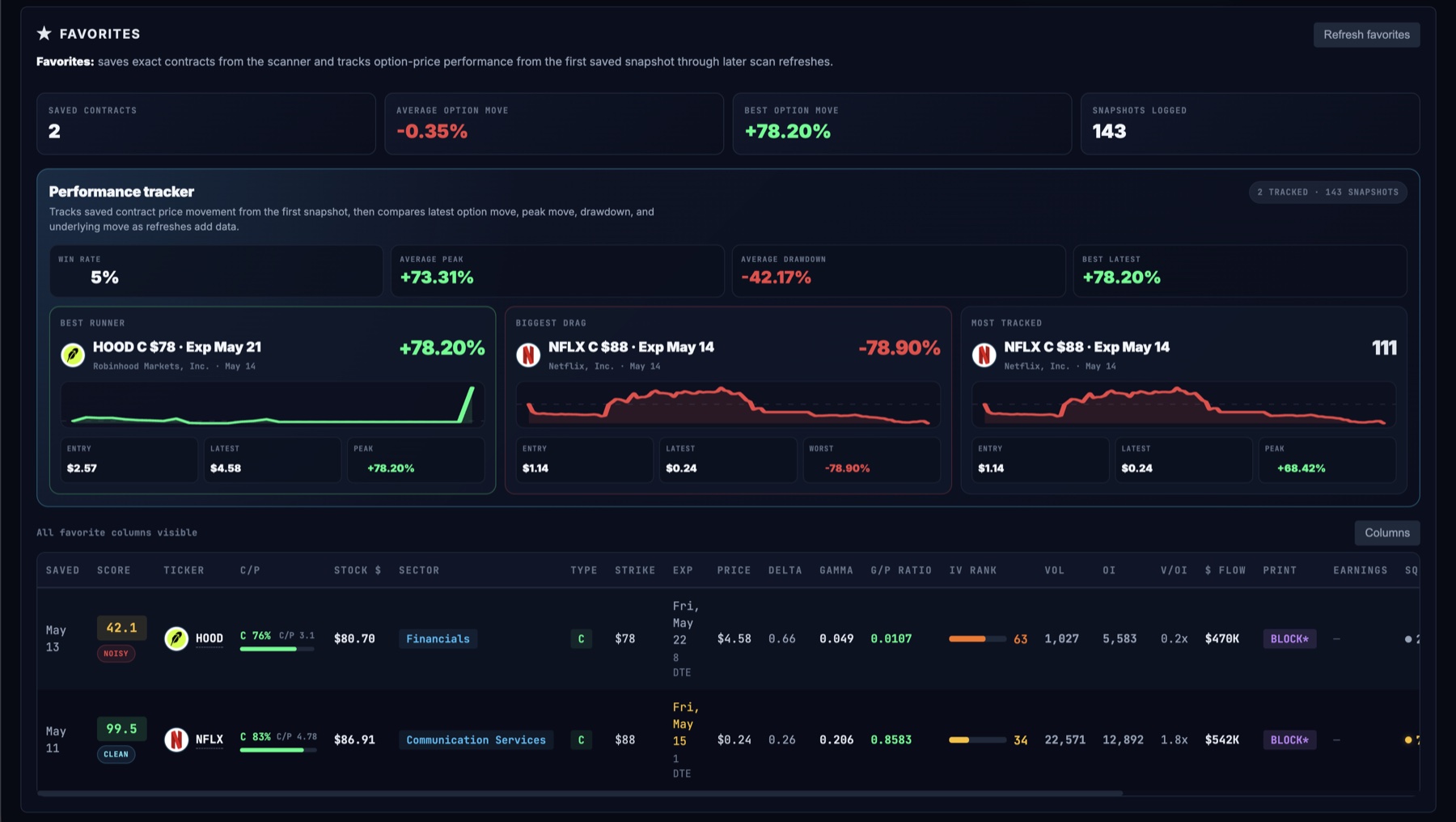
Favorites: saves exact contracts from the scanner and tracks option-price performance from the first saved snapshot through later scan refreshes.
| Saved | Score | Ticker | C/P | Stock $ | Sector | Type | Strike | Exp | Price | Delta | Gamma | G/P Ratio | IV Rank | Vol | OI | V/OI | $ Flow | Earnings | Squeeze | Option % | Underlying % | Snapshots | Remove | |
|---|---|---|---|---|---|---|---|---|---|---|---|---|---|---|---|---|---|---|---|---|---|---|---|---|
| No favorites saved yet. | ||||||||||||||||||||||||
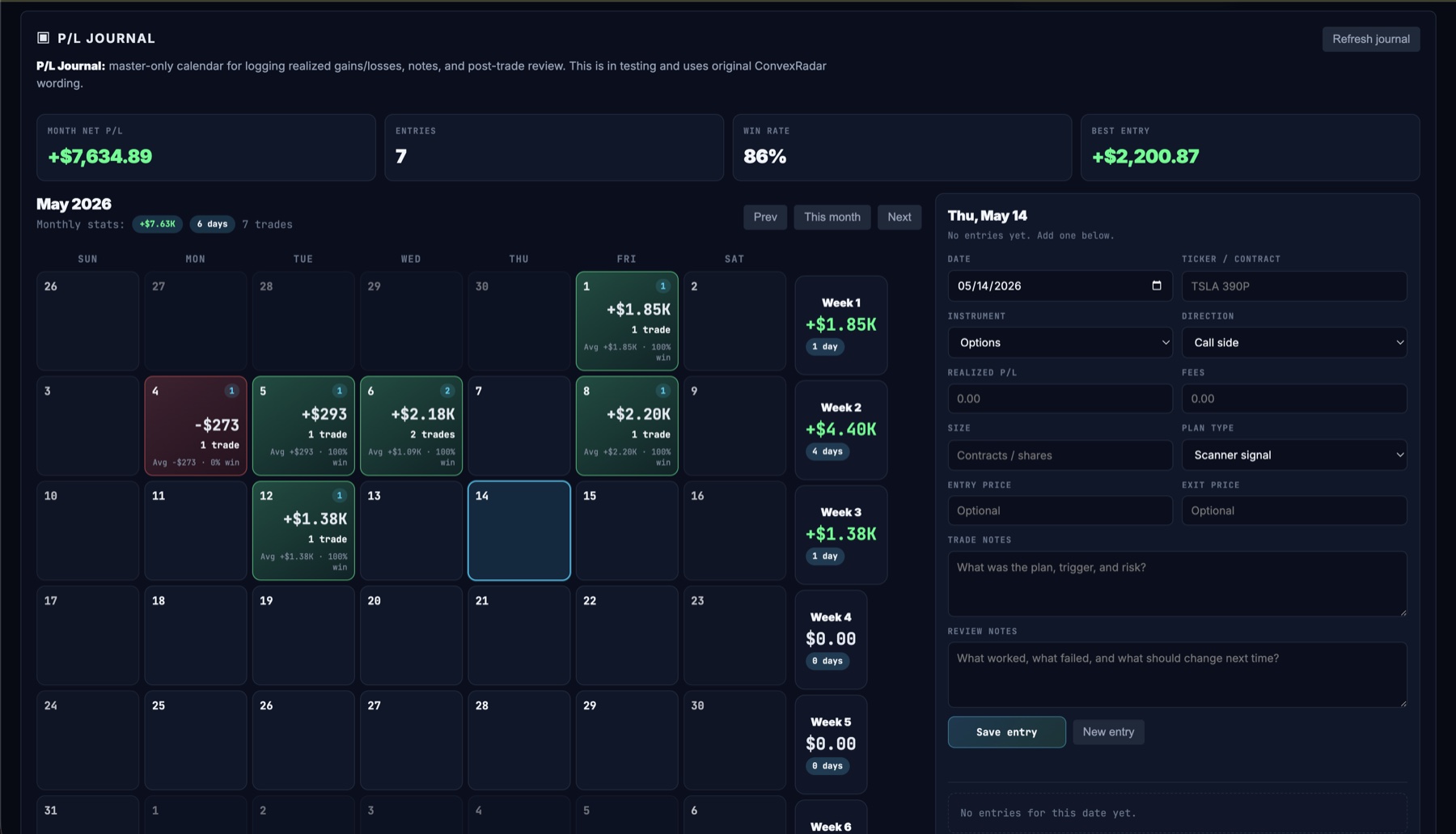
P/L Journal: Pro calendar for logging realized gains/losses, notes, and post-trade review. This is in testing and uses original ConvexRadar wording.
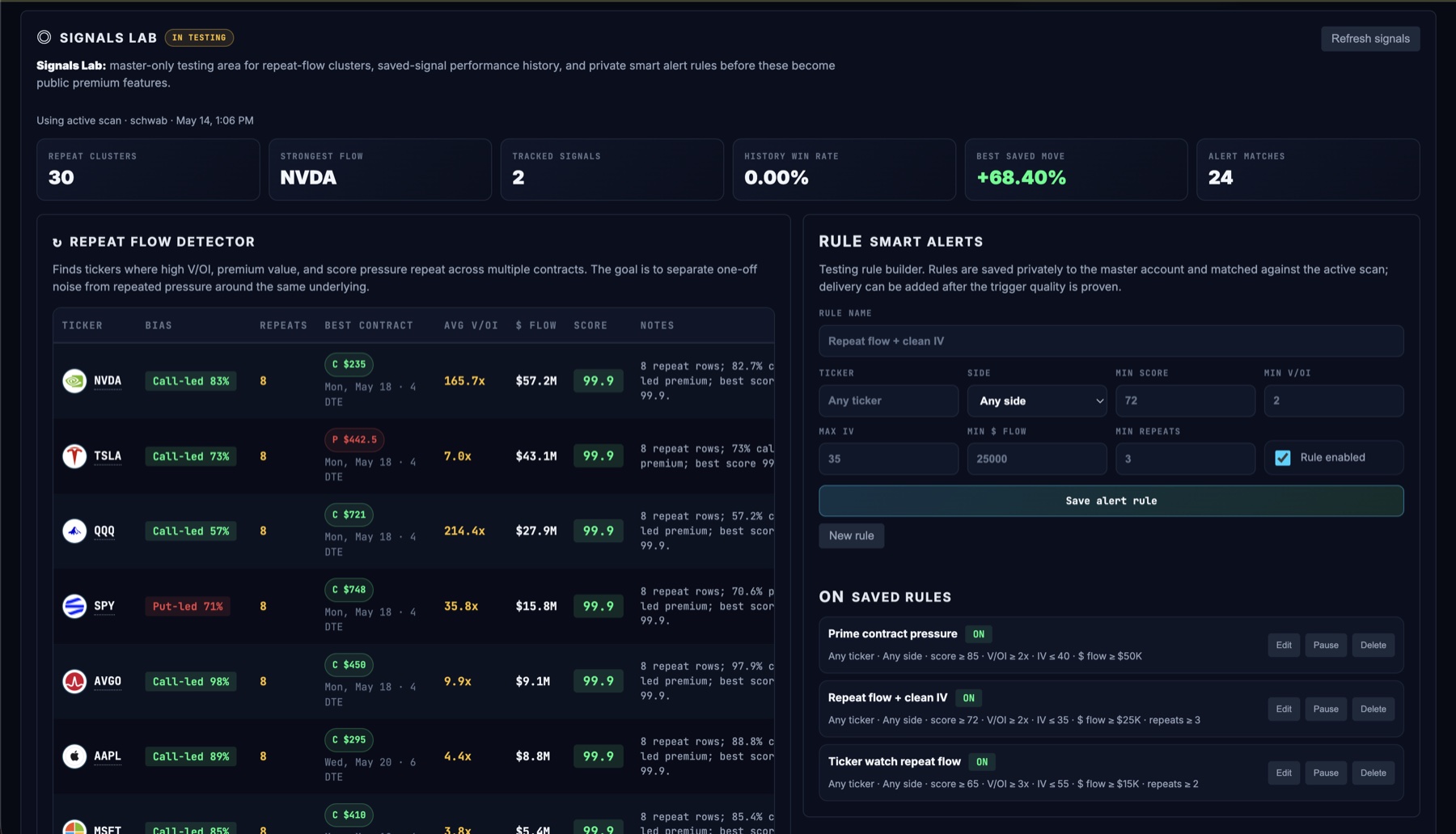
Signals Lab: Pro testing area for repeat-flow clusters, saved-signal performance history, and private smart alert rules.
Finds tickers where high V/OI, premium value, and score pressure repeat across multiple contracts. The goal is to separate one-off noise from repeated pressure around the same underlying.
| Ticker | Bias | Repeats | Best Contract | Avg V/OI | $ Flow | Score | Notes |
|---|---|---|---|---|---|---|---|
| Repeat flow not loaded yet. | |||||||
Testing rule builder. Rules are saved privately to the master account and matched against the active scan; delivery can be added after the trigger quality is proven.
Uses saved contract snapshots from Favorites to show what happened after a signal was captured. This is the foundation for ranking future alert triggers by outcomes, not just signal appearance.
| Contract | Saved | Latest | Option % | Underlying % | Max Option % | Max Drawdown | Score | Snapshots | Status |
|---|---|---|---|---|---|---|---|---|---|
| Signal performance not loaded yet. | |||||||||
| Rule | Ticker | Contract | Exp | Score | IV | V/OI | $ Flow | Repeats |
|---|---|---|---|---|---|---|---|---|
| No alert matches loaded yet. | ||||||||
Users: master-only first-party visitor analytics, signup counts, newsletter signups, and the full public account list. Visitor uniqueness is hashed per day; raw IPs and raw user agents are not stored.
| Name | Plan | Status | Provider | Password | Marketing | Trial / renewal | Updated | |
|---|---|---|---|---|---|---|---|---|
| Analytics not loaded yet. | ||||||||
ConvexRadar is already live with Live option chains, Regulatory filings, company enrichment catalysts, earnings, news, and scanner scoring. Paid beta revenue should go toward historical signal storage, alert delivery, and licensed options tape/options-flow data so the product can move from useful scanner to outcome-backed trading intelligence.
Subscription: both paid plans include a 5-day free trial. If checkout is configured, buttons open hosted checkout. If checkout is not configured yet, the same buttons add users to the beta list without charging anyone.
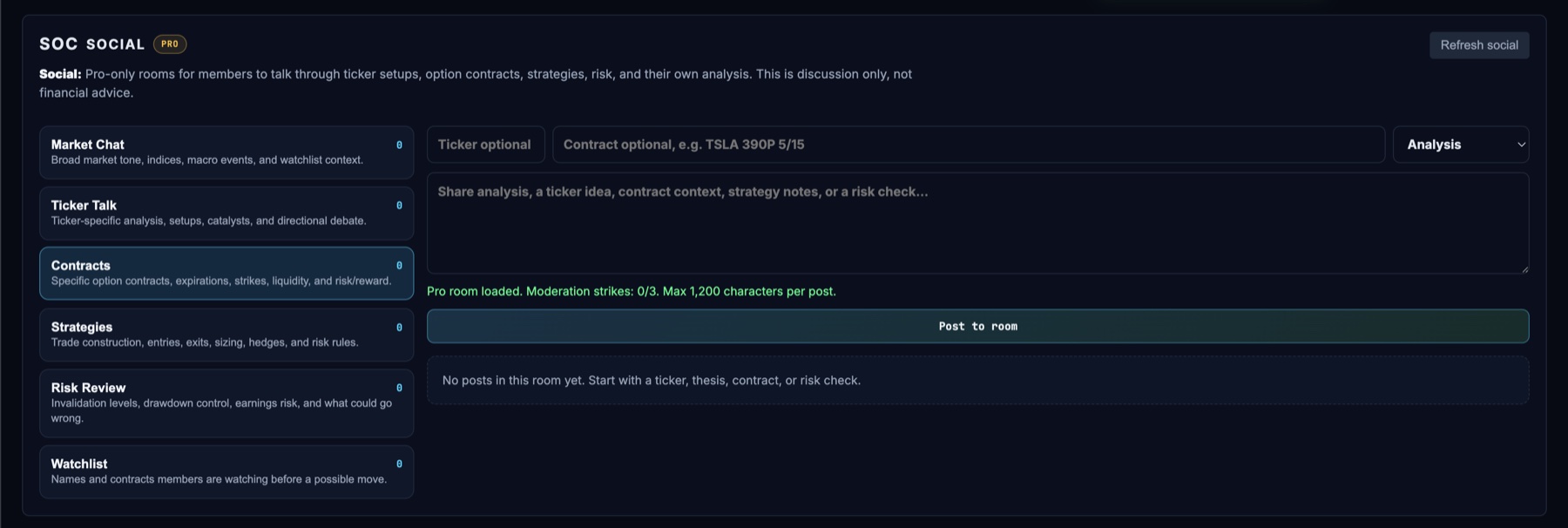
Founder Beta is built around contract research, saved contracts, and large-print review. Pro adds the advanced workflow layer: repeat-flow testing, alert rules, social rooms, and trade review.

Alerts: shows the scanner conditions that should trigger attention, such as high score, squeeze ignition, unusual V/OI, low IV rank, and large estimated premium prints.
Contracts must clear baseline quality rules before they can score. This removes illiquid, far-dated, deep OTM, and wide-spread contracts that can look cheap but are hard to trade cleanly.
The score starts with a base value, then adds or subtracts points for chain quality and catalyst intelligence. That means a contract with clean V/OI and low IV can move higher when there is fresh fresh filing activity, a target raise, insider buying, positive news sentiment, earnings support, or repeated unusual options signals.
LiquidityHigher volume gets up to 12 points so the trade is more executable.Fresh flowVolume/open-interest gets up to 16 points; volume above OI suggests new positioning.Gamma/$Gamma per dollar of premium gets up to 18 points; higher values mean more convex exposure for each dollar risked.IV rankLower IV gets rewarded because cheaper implied volatility leaves more room for expansion.Catalystsregulatory filings, analyst target changes, company enrichment, earnings timing, news sentiment, macro risk, and repeat flow can adjust the final score.The top cards use stricter rules than the table. They are meant to show only clean, directional setups, not every contract that passes the scanner.
Squeeze does not mean the stock must go up. It means the contract has short-dated convexity pressure: fresh volume versus OI, high gamma per premium, real liquidity, and nearby expiration.
IV RankLower is better by default; the table initially sorts low IV to the top.C/PPremium-weighted call/put strength by ticker. C 70% means calls are carrying most visible premium; P 70% means puts are. Top cards require at least 70% side-aligned bias; the table keeps weaker or mixed reads for review.V/OIIntraday option volume divided by open interest. Above 1x suggests fresh activity; above 2x is stronger.G/P RatioGamma per premium dollar. This highlights contracts with more potential movement sensitivity for the price paid.$ FlowEstimated premium traded: option price × 100 × volume.PrintSweep, block, and split are inferred from chain data, not exchange-level tape, unless a richer flow feed is added later.Live option chains and quotes power the scanner when connected. Regulatory filings add latest 8-K, Form 4, 13F, S-1, and 10-Q/10-K catalyst filings. Company enrichment adds analyst targets, recommendation trends, insider transactions, earnings surprises, and company news when its server-side enrichment key is configured. Earnings context feeds the earnings calendar. Charting is used for chart viewing only.
The best options platforms make raw flow readable with scanner filters, flow context, catalyst feeds, chart access, saved layouts, and quick education. ConvexRadar applies the same product pattern without treating every large print as a buy signal.
Most option-flow complaints come from noisy alerts, unclear direction, stale data, and expensive tools that still require manual interpretation. ConvexRadar is built to narrow the list first, then explain why a contract deserves review.
These features are intentionally saved for paid data scale because they need licensed options tape/flow data, deeper history, or heavier storage.
Private deployment notes load after master authentication.